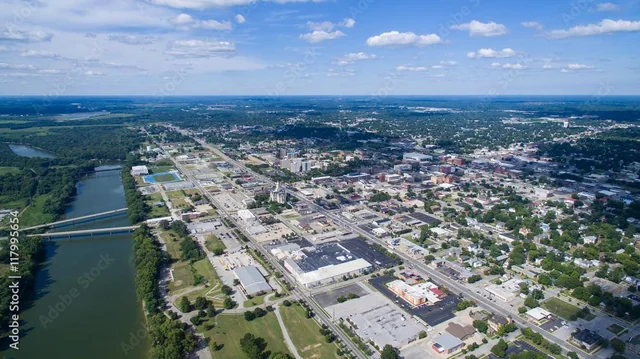
Yes — Terre Haute, Indiana is a good place to live, with the significant caveat that it rewards renters who arrive with calibrated expectations. It is not Indianapolis and does not aspire to be. What it is: one of Indiana’s most affordable cities, a genuine crossroads with easy access to two major metros, a more substantial arts and dining scene than its reputation suggests, and a job market anchored by institutions — Union Hospital, Indiana State University, Rose-Hulman — that provide stable professional employment regardless of broader economic cycles.
Cost of Living in Terre Haute
Terre Haute is consistently one of Indiana’s most affordable cities. Housing costs are significantly below Indianapolis and meaningfully below most comparable Midwest cities. A Class A two-bedroom apartment in Terre Haute — modern construction, fitness center, in-unit laundry, professional management — rents for what a one-bedroom Class B costs in Indianapolis. Groceries, utilities, and services track similarly below national averages.
For healthcare workers, university employees, and manufacturing professionals, Terre Haute’s cost structure creates genuine financial breathing room. A Union Hospital registered nurse earning $65,000-$80,000 in Terre Haute has more purchasing power than a nurse earning the same salary in Indianapolis or Chicago.
Employment in Terre Haute
Terre Haute’s economy is anchored by four stable sectors:
- Healthcare: Union Hospital on 7th Street is the dominant private employer, with a network of affiliated clinics and facilities across the Wabash Valley. Healthcare is Terre Haute’s single largest employment sector.
- Higher education: Indiana State University (west campus, west of downtown) employs thousands of faculty, staff, and administrators. Rose-Hulman Institute of Technology (US-40 east) is one of the nation’s best undergraduate engineering schools and provides additional academic employment.
- Manufacturing and logistics: The I-70/US-41 corridor draws distribution and logistics employers. The Walmart Distribution Center and associated logistics operations employ thousands of workers.
- Government and corrections: Terre Haute is home to a federal correctional complex that is one of the area’s significant employers.
Quality of Life in Terre Haute
Terre Haute has better quality-of-life assets than most people expect. Deming Park (188 acres with a zoo, disc golf, athletic facilities, and wooded walking paths) is one of Indiana’s better municipal parks. Turkey Run State Park — with Indiana’s most spectacular canyon hiking along Sugar Creek — is 40 miles north. Shakamak State Park offers lake recreation less than an hour south. The downtown Wabash Avenue corridor has developed a genuine independent restaurant scene over the past decade, anchored by the Terre Haute Brewing Company, Siam Garden, and The Saratoga Restaurant.
ISU and Rose-Hulman both contribute to a consistent calendar of arts, music, and lecture programming that gives Terre Haute intellectual and cultural activity well beyond what a city of 60,000 would typically produce.
The Crossroads Advantage
Terre Haute’s most underrated asset for renters is its location. Indianapolis is 75 miles east on I-70 — about 75 minutes. St. Louis is 175 miles west — about 2.5 hours. Chicago is reachable in under 3 hours north on US-41. Residents who want regular access to major-metro concerts, sports, airports, and medical specialties are not isolated in Terre Haute. They just don’t pay major-metro rents.
Who Terre Haute Is Right For
- Healthcare workers at Union Hospital and affiliated facilities who want clinical employment with very low housing costs
- ISU and Rose-Hulman employees who want to live near their campus without paying university-city premiums
- Manufacturing and logistics workers along the I-70/US-41 corridor
- Budget-conscious professionals relocating from larger markets who want to maximize purchasing power
- Anyone who values interstate access over urban density — Terre Haute’s crossroads position is genuinely useful
Frequently Asked Questions
What is Terre Haute, Indiana known for?
Terre Haute is historically known as the birthplace of Eugene V. Debs (labor leader) and Larry Bird (NBA legend). It was a major railroad hub in the 19th and early 20th centuries, earning the nickname “Crossroads of America.” Today it’s known for Indiana State University, Rose-Hulman Institute of Technology, the Terre Haute Brewing Company, and the federal correctional complex that includes the federal penitentiary used for high-profile federal executions.
Is Terre Haute safe?
Terre Haute has neighborhoods with varying safety profiles, as most mid-sized cities do. The north side along the US-41 corridor, the east side near Rose-Hulman, and established residential areas away from downtown have generally solid safety records. Renters should research specific addresses using local crime data and look for professionally managed communities with controlled access and on-site management presence.
Is Terre Haute growing or shrinking?
Terre Haute’s population has declined modestly over the past several decades, mirroring trends in many Midwest industrial cities. However, the metro area (Vigo County) has been more stable, and investment in the downtown corridor and healthcare sector has continued. The city is not in freefall — its institutional employers (ISU, Rose-Hulman, Union Hospital) provide an economic floor that has prevented the sharper declines seen in some Midwest cities of comparable history.
Finding an Apartment in Terre Haute
For professionally managed Class A housing in Terre Haute, explore Sycamore Terrace, managed by Gray Residential — 250 units built in 2011 in the north Terre Haute corridor, offering modern construction and professional management that stands apart from the city’s older rental inventory.
Leave a Reply